Build apps on top of SQLite

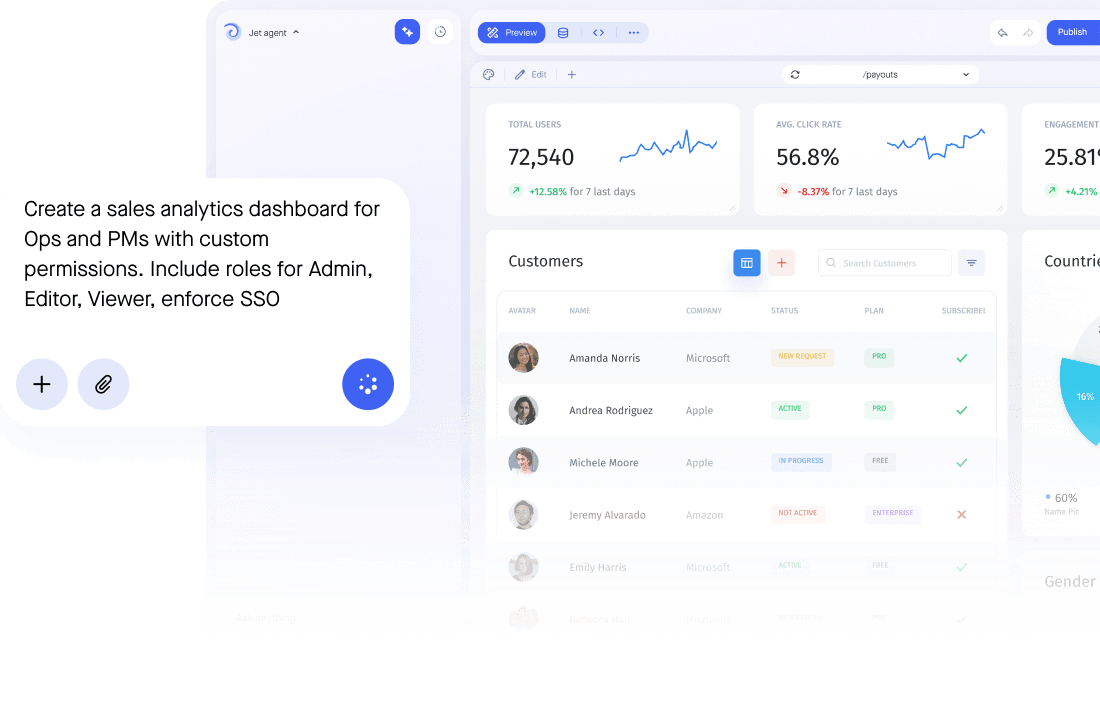
Build Admin Panels, Dashboards, and Internal Tools on top of your SQLite data with authentication, permissions, and workflows built in.


Trusted by Some of the World’s Best Product Teams

AI app builder comparison

Take SQL data further with Jet

See what a raw PostgreSQL setup gives you, and what Jet adds on top of it.
SQLite
+
Permissions & access
SQLite has no built-in users or roles at all, so a safe read-only view for one teammate means writing your own access layer or sharing the file itself.
SQLite keeps no access log of its own, so proving who saw or changed which row means building that logging yourself, from scratch.
Build secure portals and internal tools where people log in and see only their own rows, without touching the underlying file.
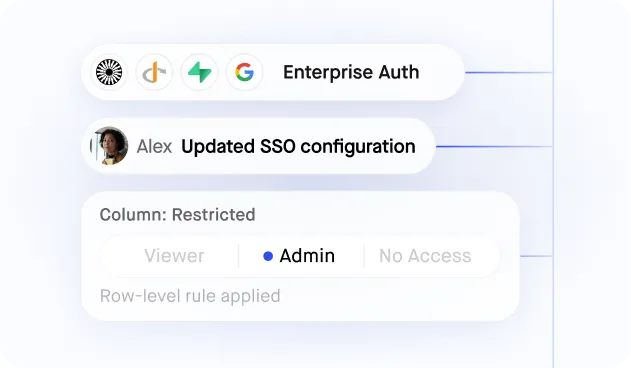
Row-level permissions, SSO and a full audit log come with every app, so a security review has an answer before it asks the question.
Interface & branding
The data lives in a single file opened with a SQL browser, which is not something you can put in front of a customer, a support agent or a new ops hire.
Ship a branded app on your own domain, with your logo and your login page, so the people using it never see a database file.
Pricing & seats
Everyone who needs a number gets a copy of the file, so there is no single source of truth or way to control who can see what.
Add viewers and external users on app pricing instead of handing out copies of the database file to every person who needs to look something up.
Workflows & AI Agents
Every business AI agent ends up with its own one-off connection to the same file, so marketing, sales and support each risk locking or corrupting it.
Reacting to a change in a SQLite file usually means a script polling it from outside, with no record of what ran or why.
Build AI agents for marketing, sales and support on top of your SQLite tables, with real permissions layered on top of a file that has none.
Trigger a workflow the moment a row changes, chaining approvals, notifications and follow-up actions with no script polling the file.
Deployment & hosting
A local file is easy to keep private, but the moment you turn it into a multi-user app most builders ask you to migrate it to their cloud first.
SQLite was built for a single writer at a time, so scaling past a handful of concurrent users usually means migrating to a server database first.
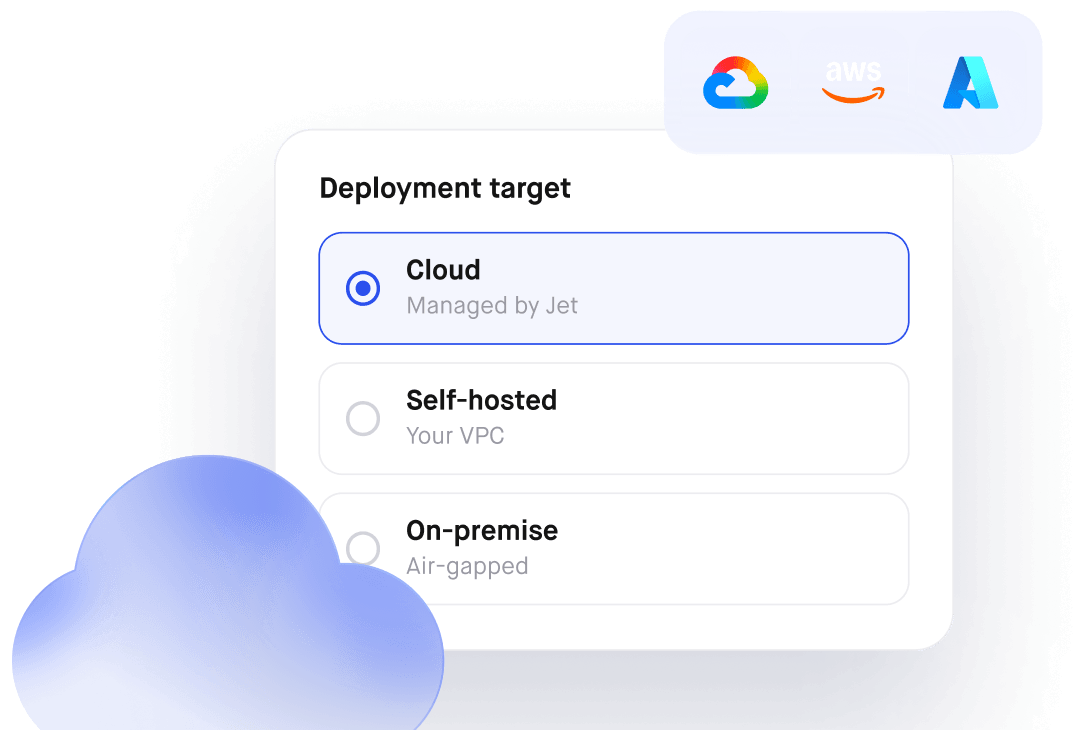
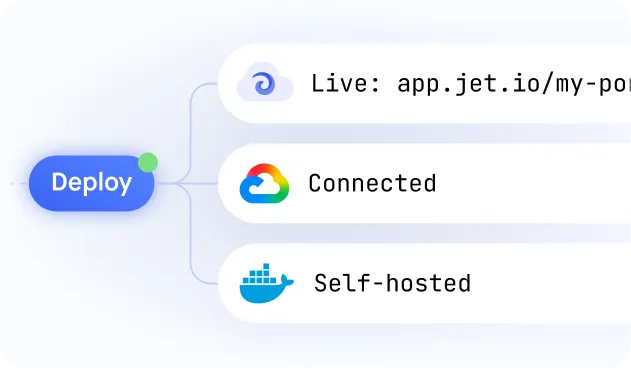
Run Jet in your own cloud account or fully on-premise, so the file and everything built on it never leaves your network.
Jet turns a SQLite file into a real multi-user backend, so the app layer ships in days, not a database migration and a developer sprint.
Dashboards & Data Integrations
Every number means someone opening the file in a SQL browser and pasting the result elsewhere, so reporting is a person rather than a page.
Add a second file or system and you are opening a second tool, so people switch tabs to see data that belongs on one screen.
Charts and metrics read live from your tables, on a screen anyone with the right role can open, without opening the file directly.
Join your SQLite tables with HubSpot, Stripe or Airtable in the same app, so one login and one screen cover every source you have.
BUILD ANYWHERE, GOVERN IN ONE PLACE

The full-stack features you need

Create a personalized, secure experience for every app user. Tailor the look and feel to align with your brand.
Create/Read/Update/Delete
All CRUD operations are generated automatically based on your database structure.
Search, Filter, Segments

Create any segments of your application data by applying a subset of filters or build an SQL query.‍‍

Manage team permissions
Manage permissions for specific users and teams without any line of code. Add users to individual dashboards and manage their access rights to specific contents directly from Jet’s interface.
Import or Export data
Import or Export data in different formats: CSV, XLS, XLSX, and JSON in a few clicks
Build Workflow
You can automate tasks like sending an email to a user when their order status changes or payment goes through. Seamlessly select triggers and link them with one or a series of actions.
Run SQL queries
Easy query your SQL database with SQL Builder allows you to analyze and calculate your data quickly and easily.

Frequently asked questions

How do I connect SQLite to Jet Admin?

Add SQLite as a resource and point Jet at the .db file, whether it is uploaded or reachable on a server you control. Jet reads the schema and generates the screens from your tables. Since SQLite allows only one writer at a time, Jet manages write access carefully to avoid conflicts.

Is there a GUI for SQLite?

Yes. Jet gives your team a spreadsheet-style editor over your SQLite tables, with search, filters, sorting and inline editing, so people who should never open a database file directly can still work with the data: support agents, operations, finance and external users, each seeing only the rows their role allows.

Can I edit my SQLite data from Jet Admin?

Yes. Writes go straight back to the file. Forms validate types and required fields before the insert, roles decide who can change what, approvals can hold the risky updates, and every change is recorded in the audit log with the person who made it, something SQLite has no built-in way to track on its own.

Does Jet Admin copy or migrate my SQLite data?

No. Jet reads and writes the file directly. There is no export to schedule and no migration to plan, so your .db file stays the single source of truth.

Is it safe to connect a production SQLite file?

SQLite has no built-in users or roles at all, so Jet is where access control actually happens: SSO and row and column level permissions decide who sees and changes what, on top of a single-writer file that Jet manages carefully to avoid write conflicts. If the file must not leave your network, Jet can run in your own cloud account or fully on-premise.

Can I connect several data sources to one app?

Yes. SQLite can sit alongside a REST API, Google Sheets or another SQL database in the same app, and a single screen can read from more than one of them at once.

What databases does Jet support?

Jet supports many databases, including MySQL, PostgreSQL, Microsoft SQL Server, Amazon Redshift, and Google BigQuery. Jet also offers integrations with popular APIs and services such as Stripe, Twilio, and Slack, making it easy to incorporate data from these sources into Jet applications. Here is a list of all our different integrations.

Who uses Jet Admin?

Diverse businesses, from startups to enterprise companies in the healthcare, finance, and e-commerce sectors. For companies that depend on internal tools, portals, and dashboards for their workflow, offering the capability to craft customized applications suited to their requirements

What is Jet Admin?

Jet Admin is a development platform that allows developers to quickly build custom business apps like internal tools, portals, dashboards for their businesses. Jet offers a drag-and-drop interface and pre-built components, making it easy to create applications while writing little code.